Tag: Geology

  • Azurite: The Mineral That Painted History

    Azurite: The Mineral That Painted History

    Every now and then, I get to write about a topic that combines geology, history, art, and a little bit of mystery. One of my favourite examples of this is a SciShow video I wrote about azurite, a striking blue mineral that humans have been using to make art for thousands of years.
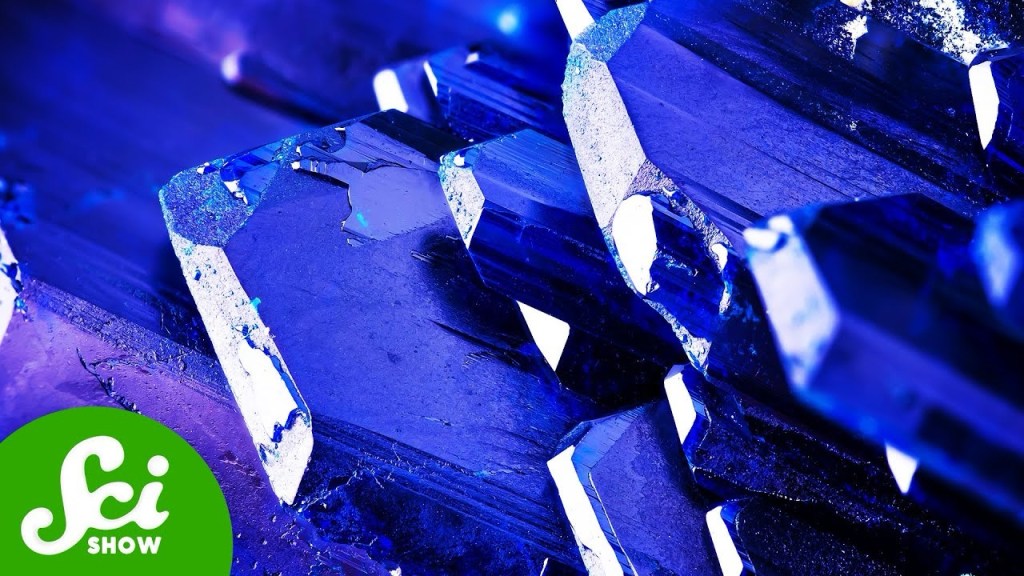
    Is this the most popular blue in all of history?

    Unlike many minerals that are prized for their sparkle or the metals they contain, azurite’s value lies in its colour. When crushed, it turns into a vivid blue powder that can be turned into pigment, and artists across the world have been doing exactly that since at least the time of the ancient Egyptians.

    Geologically, azurite is a copper carbonate mineral that forms when copper-rich rocks near the surface weather and oxidize. If you’ve ever seen a copper pipe develop a bluish-green patina, you’ve seen a similar process in action. Deposits of azurite were fairly common in parts of Europe like modern-day Slovakia, France, Hungary, and Sardinia, which made it a popular pigment during the medieval period. While ultramarine (made from lapis lazuli) was the prestige blue, it was incredibly expensive, so azurite was often used underneath to reduce the amount of ultramarine needed.

    There was a catch though. Over time, azurite can chemically alter into malachite, shifting from blue to a rather sickly green. If you’ve ever noticed medieval paintings with unexpected green patches, this mineral transformation is likely to blame.

    In China and Japan, artists took a different approach. By grinding azurite to different degrees, they created a whole palette of blues, from pale sky to deep midnight. The mineral carried symbolic meaning too, representing longevity and immortality, and during China’s Ming dynasty it became so valuable that it was collected as tax and was worth up to 2000 times the price of silver.

    And then there’s Egypt. For years, archaeologists debated whether ancient Egyptians used natural azurite alongside their famous man-made “Egyptian blue.” It took until the mid-2000s for Raman spectroscopy to confirm that yes, azurite was indeed part of their artistic toolkit. One of my favourite details is a scrap of painted leather from the time of Pharaoh Hatshepsut, featuring vivid azurite blues in a rather risqué scene.

    I loved writing this piece because it shows how a single mineral can weave through so many different stories, linking geology to art and culture across continents and millennia.

    You can watch the full video here:

  • Quartz, Craters, and the Mystery of a Lost Ice Age

    Quartz, Craters, and the Mystery of a Lost Ice Age

    Every so often, I come across a story in geology that reminds me how much of Earth we still don’t fully understand. Take the Younger Dryas: a sudden, sharp return to ice-age cold about 13,000 years ago. It coincided with the disappearance of mammoths, and with the vanishing of the Clovis people in North America. For decades, scientists have argued over what caused this dramatic cold snap. Was it ocean currents, volcanoes, or something more dramatic like an asteroid impact?

    That last idea got a huge boost in the 2010s, when radar surveys of Greenland revealed a vast, circular hole beneath the Hiawatha Glacier. Thirty kilometers wide and 300 meters deep, it looked an awful lot like an impact crater. If it were tied to the Younger Dryas, it might have been the “smoking gun” explaining why the planet suddenly chilled.

    To test the idea, scientists turned to quartz, the humble, six-sided mineral that shows up in everything from granite to jewelry to glass. Under a microscope, quartz crystals sometimes record the scars of catastrophic events. Shocked quartz, marked with telltale internal fractures, only forms under extreme pressures like those from asteroid impacts or nuclear explosions.

    Sure enough, the sand draining from under the glacier contained shocked quartz. It confirmed the hole was a true crater, blasted out by a meteorite perhaps 1.5 kilometers across, striking with the energy of 700 nuclear bombs. For a moment, the case seemed closed.

    But science rarely works in straight lines. When researchers dated the shocked quartz, they discovered the impact wasn’t 12,000 years old at all. It was 58 million years old. At the time, Greenland wasn’t icy tundra, but a forest of conifers, small mammals, and birds. The Hiawatha impact was spectacular, but it happened long before humans existed. Which meant it couldn’t explain the Younger Dryas after all.

    And yet—the quartz still whispers of catastrophe. Across sites in North America, scientists have found “lightly shocked” quartz grains in sediments just before the Younger Dryas began. These point not to a crater-forming collision, but to a comet that fragmented in the atmosphere and exploded in fiery airbursts. Such blasts could have blackened skies, scorched landscapes, and tipped the climate into chaos.

    So the Younger Dryas mystery remains, balanced between competing hypotheses. But thanks to quartz—ordinary, abundant quartz—we’re at least narrowing in on the truth. It’s humbling to think that the fate of entire ecosystems and cultures can be written in the microscopic scars of a mineral.

    Watch the full video I wrote for SciShow here:

  • Why Some Earthquakes Hit Harder Than Others

    Why Some Earthquakes Hit Harder Than Others

    On May 5th 2024, a 4.8 magnitude earthquake shook New Jersey. It was the first sizeable quake the region had seen in years, and it made headlines across the US. What struck me, though, was how different the response was compared to the west coast, where quakes of that size happen fairly often without much fuss.

    That contrast became the focus of a SciShow episode I wrote recently. On the surface, a 4.8 is a 4.8, no matter where it happens. But as I dug into the research, I was reminded that geology has a way of complicating even the neatest numbers.

    The Richter scale, devised back in 1935, gave us a standard way of measuring quakes, but it was built on data from California and never really worked worldwide. These days, scientists use moment magnitude instead. It’s a more robust calculation that takes into account the properties of the rocks and the fault itself. Still, even that number can’t tell you everything about what an earthquake will feel like.

    The real story is in the rocks. On the east coast, the crust is old, dense, and continuous, so seismic energy can travel astonishing distances. That’s why a 5.8 quake in Virginia in 2011 was felt almost 1,000 kilometers away, while a stronger quake in California barely carried half as far.

    Then there’s the effect of what’s underfoot. If you’re standing on solid bedrock, the shaking might feel sharp but brief. But if you’re on softer sediments, the waves get amplified and drawn out. Mexico City, Christchurch, Los Angeles, all cities built on basins and old lakebeds, have all suffered devastating consequences from this “jello effect.”

    One of the most fascinating (and sobering) examples I came across was the 2001 Gujarat earthquake in India. It measured 7.7 in magnitude and was felt over 1,000 kilometers away, causing tens of thousands of deaths. Just three years later, the enormous Sumatra-Andaman quake struck with a magnitude over 9. While it unleashed a catastrophic tsunami, the shaking itself wasn’t felt nearly as far afield. Same planet, same process, but completely different outcomes because of local geology.

    Writing this episode was a good reminder that magnitude isn’t the whole story. Whether an earthquake feels like a distant rumble or topples buildings depends on the deep, complicated history written into the rocks beneath us.

    Watch the full video here:

  • The World’s Biggest Geode (and How It Saved a Winery)

    The World’s Biggest Geode (and How It Saved a Winery)

    Like many children, I was captivated by museum gift shops, especially the shelves of glittering geodes. Crack one open and you’re rewarded with a surprise display of crystals hidden inside. Those pocket-sized treasures, though, are nothing compared to the largest geode in the world – one so vast it could swallow the entire gift shop whole.

    Interior of a geode cave with large, crystalline formations on the ceiling, two visitors gazing in awe at the stunning mineral display.

    The story begins in 1897 on South Bass Island, Ohio, where German-American winemaker Gustav Heineman had set up a vineyard. When he ordered a well to be dug to supply water for his vines, workers broke into a cavern 12 metres down. Instead of solid rock, they found a cave lined with enormous crystals.

    The cave’s origins trace back hundreds of millions of years. During the Silurian period, 430 million years ago, this part of North America was covered by shallow seas. Layers of sedimentary rock formed, including lenses of the evaporite mineral anhydrite (calcium sulfate). Fast forward to the end of the last Ice Age: meltwater from retreating glaciers and nearby Lake Erie seeped through the rocks, dissolving the anhydrite and leaving behind empty cavities.

    Normally, these spaces might become crystal-lined geodes filled with quartz or amethyst. But here, something unusual happened. The groundwater was rich in strontium. As it interacted with the dissolving anhydrite, calcium ions were replaced by strontium, forming celestine – pale blue, glassy crystals of strontium sulfate. Over thousands of years, they grew to extraordinary sizes, some more than a metre across, filling the cavern with their sky-coloured sparkle.

    The cave, however, didn’t remain untouched. In the early 20th century, miners extracted around 150 metric tons of celestine crystals, not as souvenirs but as a source of strontium for the fireworks industry, where it produced a brilliant crimson flame. The removal enlarged the cavern to its current size – 11 metres across and tall enough to stand in.

    Recognising an opportunity, Heineman’s son Norman opened the cave to visitors in 1919. The timing was fortuitous: during Prohibition, when most Ohio wineries were forced to shut, ticket sales to the “Crystal Cave” (along with grape juice) kept the business alive.

    Today, more than a century later, the Heineman Winery and its glittering celestine cavern still welcome tourists, making South Bass Island home to both award-winning wines and the largest geode on Earth.


    This year I’ve had the pleasure and privilege of writing a series of mineral-focused scripts for SciShow’s limited-run Rocks Box subscription. It’s been such a joy being able to nerd out about rocks and minerals. I’ll write about anything, but geology will always be my first love. Watch this space for many more rocks-related updates!

    Watch the full video from SciShow here:

  • Epidote: The Green Mineral That Could Hold Clues to Life’s Origins

    Epidote: The Green Mineral That Could Hold Clues to Life’s Origins

    At first glance, epidote might look like a perfectly ordinary rock: greenish, slightly glassy, nice enough to put on your bookshelf. But this mineral is far more than just decoration. Epidote could help unlock the mystery of life’s earliest origins on Earth, and perhaps even beyond.

    The fossil record is our best archive for understanding the history of life, but it has limits. The deeper back in time you go, the harder it becomes to find intact fossils. Earth’s plate tectonics are constantly recycling rocks, and the fossils that do survive tend to be battered, squashed, or melted beyond recognition. Add to this the fact that the earliest life forms were likely tiny, soft, and strange-looking, and the trail of evidence gets very faint indeed.

    That’s where minerals like epidote come into play. Formed when hot fluids percolate through volcanic rocks in a process known as epidotization, this mineral often appears in striking pistachio-green veins. On Earth today, these hydrothermal systems occur at places like mid-ocean ridges and subduction zones, where scalding fluids rise from cracks in the crust to form black smoker chimneys. Despite the heat, these are thriving ecosystems, and many scientists think they resemble the extreme environments where life first emerged billions of years ago.

    Because epidote is a signature of ancient hydrothermal activity, finding it in very old rocks can point us to past habitats where early microbes might have lived. That’s exactly what researchers in the Pilbara region of northwestern Australia have been doing. The Pilbara hosts some of the world’s oldest rocks, dating back 3.5 billion years, along with some of the earliest fossil evidence of simple, bacteria-like life. These fossils are fragmentary, but the presence of epidotized rocks helps scientists target the ancient hydrothermal systems where life may once have thrived.

    Epidote isn’t just about Earth’s history either. Since it flags hydrothermal activity, and by extension, potential habitability, it’s also a mineral of interest on Mars. NASA’s Spirit and Opportunity rovers have already detected trace amounts of epidote on the Red Planet, and future missions will keep watch for more. If found in the right context, those green veins could be a roadmap to places where Martian life once might have had a chance.

    So, next time you see a small green crystal of epidote, remember: it’s more than just a mineral. It’s a window into life’s extreme beginnings, and perhaps a guide to finding it elsewhere in the solar system.


    This year I’ve had the pleasure and privilege of writing a series of mineral-focused scripts for SciShow’s limited-run Rocks Box subscription. It’s been such a joy being able to nerd out about rocks and minerals. I’ll write about anything, but geology will always be my first love. Watch this space for many more rocks-related updates!

    Watch the full video from SciShow here:

  • How Ancient Glass Could Transport Life Between Planets

    How Ancient Glass Could Transport Life Between Planets

    For over 20,000 years, Aboriginal Tasmanians have collected and traded beautiful, glassy rocks now known as Darwin Glass. But these tektites—formed 816,000 years ago by a meteorite impact—are more than just striking artifacts. Scattered across western Tasmania, Darwin Glass is the molten residue of a high-energy collision that vaporised rock, blasted molten debris into the sky, and formed a crater over a kilometre wide.

    Uniquely, this impact site was waterlogged—covered in rainforests and swamps—which made the collision unusually “splashy.” The result: an enormous strewn field of glass, and a rich scientific mystery. Within some pieces of Darwin Glass, scientists have discovered organic molecules—plant-based polymers like cellulose and lignin—trapped and preserved in glass bubbles.

    These findings suggest that tektites can act like time capsules, capturing snapshots of ancient life. They also raise intriguing possibilities for astrobiology: if life’s building blocks can survive inside impact glass on Earth, could similar glasses on Mars preserve traces of ancient Martian life? Could interplanetary collisions even spread life across the solar system?

    Darwin Glass offers a powerful reminder: in the aftermath of cosmic catastrophe, we might find the clues to life’s endurance—and its origins.


    In writing this video for SciShow, I was fascinated to discover just how widespread these impact glasses really are. With a chemical composition that matches the local rocks where the impact happened, the size of the strewn field usually corresponds to the size of the impact, and gives us a window into the catastrophic events of the past.

    Unfortunately, the glasses are prone to weathering and breakdown, so we don’t have any from earths earliest periods, but I like to imagine that one day we will tap into a rich seam of tektites from the late Archean, containing the smoking gun for the origin of life. Hey, a girl can dream!