Tag: Palaeontology

  • Epidote: The Green Mineral That Could Hold Clues to Life’s Origins

    Epidote: The Green Mineral That Could Hold Clues to Life’s Origins

    At first glance, epidote might look like a perfectly ordinary rock: greenish, slightly glassy, nice enough to put on your bookshelf. But this mineral is far more than just decoration. Epidote could help unlock the mystery of life’s earliest origins on Earth, and perhaps even beyond.

    The fossil record is our best archive for understanding the history of life, but it has limits. The deeper back in time you go, the harder it becomes to find intact fossils. Earth’s plate tectonics are constantly recycling rocks, and the fossils that do survive tend to be battered, squashed, or melted beyond recognition. Add to this the fact that the earliest life forms were likely tiny, soft, and strange-looking, and the trail of evidence gets very faint indeed.

    That’s where minerals like epidote come into play. Formed when hot fluids percolate through volcanic rocks in a process known as epidotization, this mineral often appears in striking pistachio-green veins. On Earth today, these hydrothermal systems occur at places like mid-ocean ridges and subduction zones, where scalding fluids rise from cracks in the crust to form black smoker chimneys. Despite the heat, these are thriving ecosystems, and many scientists think they resemble the extreme environments where life first emerged billions of years ago.

    Because epidote is a signature of ancient hydrothermal activity, finding it in very old rocks can point us to past habitats where early microbes might have lived. That’s exactly what researchers in the Pilbara region of northwestern Australia have been doing. The Pilbara hosts some of the world’s oldest rocks, dating back 3.5 billion years, along with some of the earliest fossil evidence of simple, bacteria-like life. These fossils are fragmentary, but the presence of epidotized rocks helps scientists target the ancient hydrothermal systems where life may once have thrived.

    Epidote isn’t just about Earth’s history either. Since it flags hydrothermal activity, and by extension, potential habitability, it’s also a mineral of interest on Mars. NASA’s Spirit and Opportunity rovers have already detected trace amounts of epidote on the Red Planet, and future missions will keep watch for more. If found in the right context, those green veins could be a roadmap to places where Martian life once might have had a chance.

    So, next time you see a small green crystal of epidote, remember: it’s more than just a mineral. It’s a window into life’s extreme beginnings, and perhaps a guide to finding it elsewhere in the solar system.


    This year I’ve had the pleasure and privilege of writing a series of mineral-focused scripts for SciShow’s limited-run Rocks Box subscription. It’s been such a joy being able to nerd out about rocks and minerals. I’ll write about anything, but geology will always be my first love. Watch this space for many more rocks-related updates!

    Watch the full video from SciShow here:

  • How Ancient Glass Could Transport Life Between Planets

    How Ancient Glass Could Transport Life Between Planets

    For over 20,000 years, Aboriginal Tasmanians have collected and traded beautiful, glassy rocks now known as Darwin Glass. But these tektites—formed 816,000 years ago by a meteorite impact—are more than just striking artifacts. Scattered across western Tasmania, Darwin Glass is the molten residue of a high-energy collision that vaporised rock, blasted molten debris into the sky, and formed a crater over a kilometre wide.

    Uniquely, this impact site was waterlogged—covered in rainforests and swamps—which made the collision unusually “splashy.” The result: an enormous strewn field of glass, and a rich scientific mystery. Within some pieces of Darwin Glass, scientists have discovered organic molecules—plant-based polymers like cellulose and lignin—trapped and preserved in glass bubbles.

    These findings suggest that tektites can act like time capsules, capturing snapshots of ancient life. They also raise intriguing possibilities for astrobiology: if life’s building blocks can survive inside impact glass on Earth, could similar glasses on Mars preserve traces of ancient Martian life? Could interplanetary collisions even spread life across the solar system?

    Darwin Glass offers a powerful reminder: in the aftermath of cosmic catastrophe, we might find the clues to life’s endurance—and its origins.


    In writing this video for SciShow, I was fascinated to discover just how widespread these impact glasses really are. With a chemical composition that matches the local rocks where the impact happened, the size of the strewn field usually corresponds to the size of the impact, and gives us a window into the catastrophic events of the past.

    Unfortunately, the glasses are prone to weathering and breakdown, so we don’t have any from earths earliest periods, but I like to imagine that one day we will tap into a rich seam of tektites from the late Archean, containing the smoking gun for the origin of life. Hey, a girl can dream!

  • What was the first predator?

    What was the first predator?

    Whenever I tell people that I was a palaeontologist, I invariably get one of two responses:

    “Oh, like Ross from friends?!” or

    “Oh, my kid LOVES dinosaurs”

    …and then I have to witness their disappointment when I tell them that actually, my kind of palaeontology is a lot older and a lot less…toothy.

    Since leaving academia and becoming more of a palaeontological generalist, I’ve dabbled in the recent world of the macroscopic, and with History of the Earth I have had the opportunity to write about everything from the first spark of life, through mineralisation, right up to the lives and deaths of the dinosaurs. I love how the perspective of the whole story of life on (and off) Earth can help us understand and appreciate each era on a deeper level.

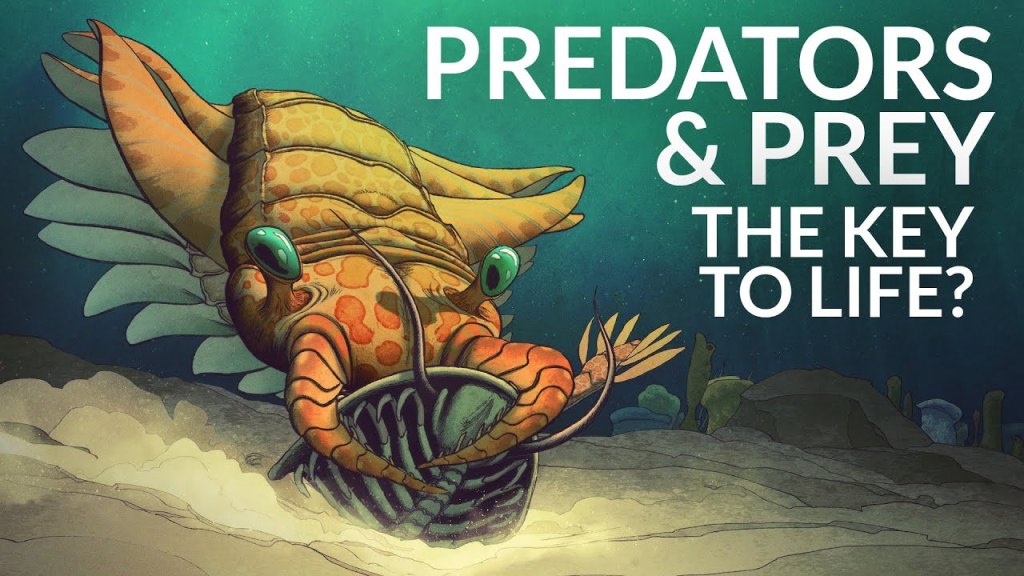
    My latest video for the channel: ‘What was the First Predator on Earth?’ is no exception. For most of Earth’s history, life got by with the simplest of two-tiered food chains. Priamry producers took energy from the sun or the earth and turned it into nutritious organic molecules. And opportunistic consumers and decomposers used those organic molecules for their food. So far, so peacefully pastoral. But with the rise of animals, their larger size and larger energy requirements called for a new approach leading, a scant few million years after the Cambrian Explosion, to the first apex predator: Anomalcaris.

    This video takes us on a journey from the surprising discovery of anomalcaris thanks to an unthinkable act of fossil destruction, through the roles and ramifications of predation in an ecoystem, the ever-accelerating arms race that predator-prey interactions ignite, to finally how we can use the fossil evidence to interpret how anomalocaris lived in the Cambrian seas.

    It was such a fun video to write, and a great story that pulls together principles of ecology, evolution, and traditional palaeontological endeavor. Almost makes me wish I was back at the coalface. Almost.

    Give it a watch and tell me what you think? And yes, it is uncanny how anomalocaris looks like Trump in the thumbnail!